
From Biomass to Biochar :
Partial Pyrolysis
Burning of Agricultural Waste in a Kon-Tiki
The Kon-Tiki method is a simple and efficient way to convert agricultural waste into biochar using a controlled burning process called flame-cap pyrolysis. This technique allows farmers to safely convert crop residues into a stable form of carbon that can be returned to the soil, instead of being lost through open-field burning.
- Collection and Preparation of Biomass
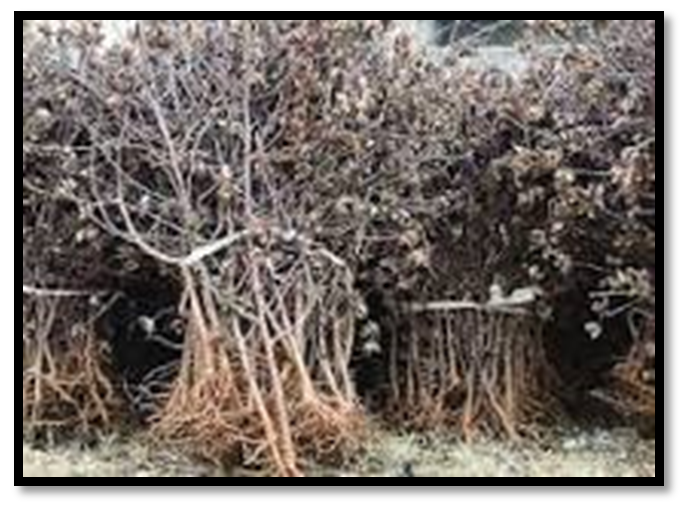
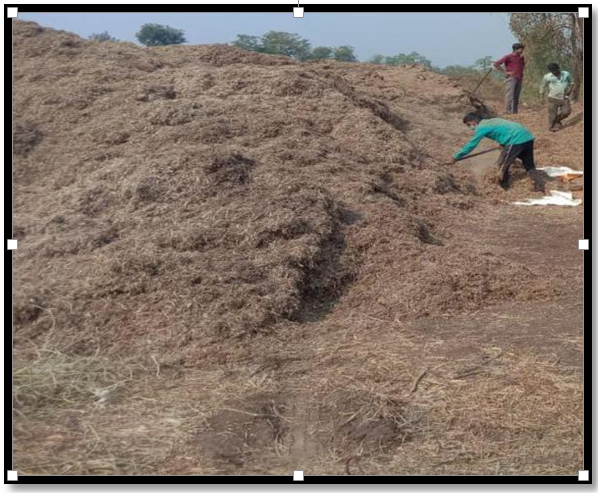
Agricultural residues such as cotton stalks, pigeon pea stalks and orchard pruning are collected after harvest. The biomass is cut into manageable sizes (typically 5–50 cm) to ensure uniform burning. Moisture content is reduced by sun-drying so that the material ignites easily and burns cleanly. This step is important because wet biomass creates smoke and reduces biochar quality.
- Loading and Ignition
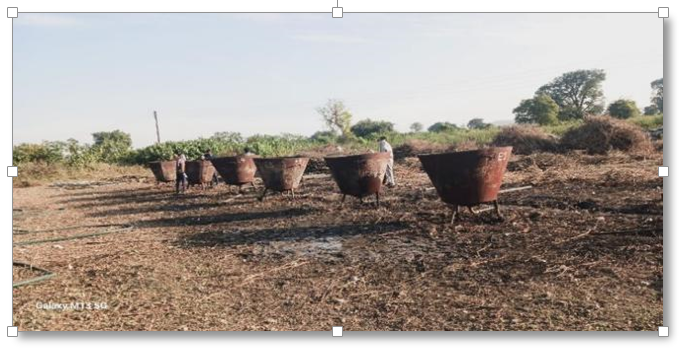
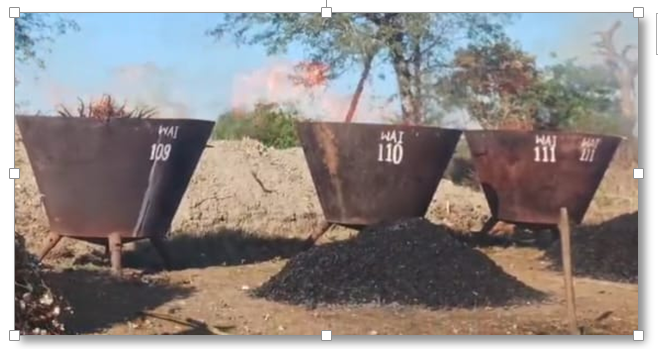
The Kon-Tiki is a cone-shaped steel or earthen kiln designed to control airflow during burning. A small amount of dry biomass is placed at the bottom and ignited using a fire stick or natural kindling.
Once the first layer is burning well, more biomass is gradually added on top in thin layers. This is the key difference between Kon-Tiki and open burning.
- Flame-Cap Pyrolysis
As each new layer is added, the burning happens only at the top. The flame at the surface consumes oxygen and creates a hot, low-oxygen zone below it. In this oxygen-limited environment, the lower biomass does not burn into ash but instead undergoes pyrolysis, meaning it is thermally decomposed into solid carbon (biochar), gases, and vapors.
The flame above burns off most of the smoke and gases, which greatly reduces visible pollution and harmful emissions compared to open-field burning.
- Conversion to Biochar
Layer by layer, the biomass below the flame turns into black, porous, carbon-rich biochar. This material is chemically stable and can store carbon in the soil for hundreds to thousands of years. Typically, about 30–40% of the original biomass weight is converted into biochar. For example, from 1 tonne of dry cotton stalks, around 300–400 kg of biochar can be produced.
- Quenching and Cooling
Once the kiln is full and the top layer has turned into glowing char, the fire is stopped by adding water or covering the kiln with soil. This quenches the material and prevents the biochar from burning into ash. Rapid cooling preserves the carbon structure and maintains high biochar quality.
- Crushing and Application
After cooling, the biochar is removed and crushed into smaller particles. It can then be mixed with compost, cow dung slurry, or nutrients and applied to farmland. This improves soil fertility, water holding capacity, and microbial activity.
Why Kon-Tiki is Better Than Open Burning
In open burning, crop residues are burned completely, releasing carbon dioxide, methane, and harmful smoke into the atmosphere, leaving only ash. In contrast, the Kon-Tiki process converts a large portion of biomass carbon into stable biochar, locking carbon into the soil while producing far fewer emissions.
Thus, Kon-Tiki transforms agricultural waste from a pollution problem into a climate solution and a source of income for farmers.