From Biomass to Biochar :
Complete Pyrolysis Process
Industrial Biochar Production Through PyrolysisText Here
Industrial biochar is a high-carbon, stable material produced by the controlled thermal decomposition of biomass under limited or no oxygen conditions, a process known as pyrolysis. This advanced thermochemical process converts agricultural residues and organic waste into a valuable carbon-rich product while minimizing emissions and maximizing resource efficiency.
The Pyrolysis Process
In industrial pyrolysis systems, selected biomass feedstocks—such as crop residues, forestry waste, or agro-industrial by-products—are subjected to elevated temperatures (typically 350–700 °C) in an oxygen-restricted environment. Unlike open burning, pyrolysis prevents complete combustion, enabling controlled conversion of biomass into:
- Biochar (solid carbon fraction)
- Syngas (combustible gases)
- Bio-oil (condensable vapors)
Modern industrial units are designed to recover and reuse process heat and syngas, improving overall energy efficiency and reducing external fuel requirements.
Key Characteristics of Industrial Biochar
- High fixed carbon content and long-term stability
- Porous structure with large surface area
- Low bulk density and high adsorption capacity
- Chemically and biologically stable in soil and industrial applications
These properties make industrial biochar a versatile material suitable for agricultural, environmental, and industrial uses.
Applications of Industrial Biochar
Agriculture & Soil Health
Biochar improves soil structure, water-holding capacity, nutrient retention, and microbial activity, leading to enhanced crop productivity and long-term soil resilience.
Carbon Sequestration & Climate Action
Due to its stable carbon form, biochar acts as a long-term carbon sink, supporting climate-smart agriculture and carbon credit mechanisms.
Environmental & Industrial Uses
Biochar is increasingly used in wastewater treatment, air purification, composting, and as a filler or additive in construction materials and industrial composites.
Agriculture Waste to Bio-CNG
Converting agricultural waste into Compressed Natural Gas (Bio-CNG) is a sustainable and commercially proven pathway for clean energy production.
Crop residues, animal waste, and agro-industrial by-products are processed through anaerobic digestion, where organic matter is biologically converted into biogas.
The raw biogas is then upgraded by removing impurities such as CO₂, H₂S, and moisture to produce high-purity Bio-CNG. This renewable gas has properties comparable to conventional natural gas and can be used in transport, industry, and cooking applications.
Agriculture waste–to–CNG projects address the critical challenge of crop residue burning while creating decentralized energy infrastructure.
The by-product digestate serves as a nutrient-rich organic fertilizer, supporting soil health and circular agriculture.
The process supports national energy security, clean mobility goals, and climate action commitments. With scalable technology, assured feedstock availability, and policy support, agriculture waste to CNG represents a viable, impact-driven investment opportunity.
This integrated model transforms farm waste into clean fuel, organic fertilizer, and long-term environmental value.
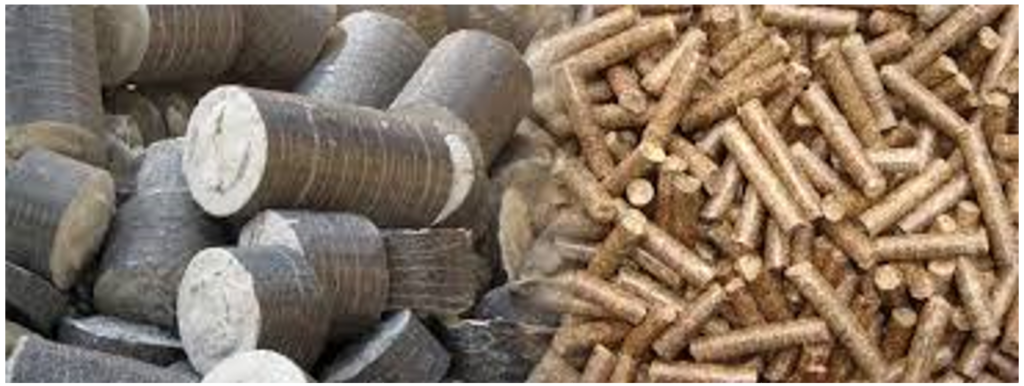
Biomass Densification
Biomass densification converts low-density biomass or biochar into standardized, high-value briquettes and pellets, creating scalable, tradable products with improved logistics and consistent performance. This process unlocks commercial value from agricultural waste, reduces supply-chain costs, and supports dual revenue streams through fuel markets, soil applications, and carbon-linked products. As a capital-efficient, modular technology, briquetting and pelletization enhance margins while enabling rapid scale-up across regions.
Bottom of Form